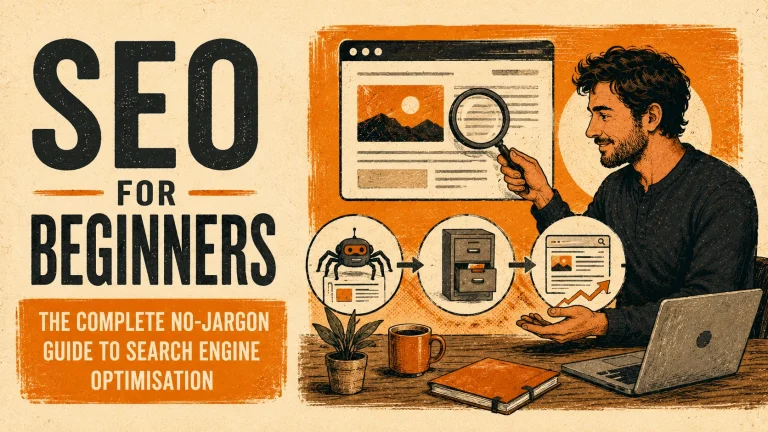
The History of SEO: From Keyword Stuffing to AI Search in 2026
At SEO for Authority Sites, we spend a lot of time thinking about where search is headed. But to understand where it’s headed, it helps to understand where it’s been. You don’t have to go particularly far back in time to trace the full arc of Search Engine Optimisation, it’s only really been around for a few decades, yet the way we optimise websites for search has changed almost beyond recognition in that time.
What was once considered perfectly normal SEO practice, stuffing a page with keywords, building thousands of backlinks, spinning articles or creating pages specifically for search engines rather than people, can now do more harm than good. The search engines have become considerably better at understanding what a website is actually about, what a searcher is genuinely looking for, and whether a piece of content deserves to appear in the results at all.
And in 2026, SEO is changing again. Google Search is no longer simply a list of ten blue links. It now weaves together maps, images, videos, shopping results, featured snippets, local results, AI Overviews and AI Mode into a single experience. Google is increasingly using artificial intelligence to understand queries and generate answers directly, while still relying on the underlying web to find, verify and assess useful information.
That doesn’t mean SEO is disappearing. It means it’s becoming more sophisticated. Technical SEO still matters. Content still matters. Links still matter. User experience still matters. But the days of hunting for one magic ranking trick are long gone, and the history of SEO gives us a genuinely useful lens for understanding why that trick was never going to last, as we’ve covered in our own guide to analysing what’s actually working for your competitors, the businesses that win today are the ones building real strategy, not chasing shortcuts.
A Short History of SEO
The first website went online in 1991, created by Tim Berners-Lee at CERN. As the World Wide Web grew from a handful of pages into something genuinely vast, people quickly needed a way of finding all these new websites. Early search engines and directories such as Archie, Yahoo!, WebCrawler, Lycos, Excite and AltaVista helped users discover information online. Yahoo!, in particular, originally operated more like a directory than a search engine, with websites organised by hand into categories the way a library organises books by subject.
These early search engines were considerably more basic than what we use today. They relied heavily on the literal information contained within a webpage: the words appearing in the content, the page title, the headings and other HTML elements. This created an obvious and, in hindsight, entirely predictable opportunity. If search engines used keywords to determine relevance, then webmasters could simply add more keywords. And that is exactly what happened.
The Rise of Search Engine Manipulation
As search became an important source of website traffic, businesses quickly realised that ranking highly could generate visitors, leads and sales almost for free. SEO became an industry in its own right, and unfortunately, so did the attempts to manipulate it.
Keyword stuffing became rampant. Some websites would repeat the same keyword dozens or even hundreds of times on a single page, sometimes hiding the text from human visitors while leaving it fully visible to search engine crawlers. Alongside this sat a whole ecosystem of other tactics: doorway pages built purely to funnel search traffic, cloaking that showed search engines a different page to the one a visitor would see, automatically generated content, article spinning that reworded the same piece dozens of times, comment spam, and large-scale link schemes designed purely to game the algorithm.
Backlinks became particularly prized. The underlying idea was actually sensible: if reputable websites link to your website, that’s a reasonable signal that your content is useful. The problem was that SEOs quickly discovered they could manufacture that signal artificially. Directories, link networks, paid links, blog comments and armies of low-quality websites could all be used to fabricate authority that had never really been earned.
For a while, this worked remarkably well, because search engines were effectively playing catch-up with the people trying to manipulate them. The result wasn’t particularly good for searchers. A website that understood how to game an algorithm could outrank a website that actually provided the better, more useful answer to the question someone had actually asked. Google was about to change that dynamic entirely.
How Google Changed SEO
Google was founded by Larry Page and Sergey Brin while they were students at Stanford University. The company was incorporated in 1998, although the Google.com domain had been registered a year earlier, in 1997. Page and Brin’s research introduced a fundamentally different way of determining the importance of a webpage.
One of the foundations of that approach was PageRank, which analysed the relationships between webpages through the links connecting them. Rather than relying purely on the words appearing on a page, the idea was that links could reveal something about the importance and authority of that page, treating each link a little like an academic citation vouching for the page it pointed to. PageRank became one of the pillars of Google’s early success, and it’s worth noting that it hasn’t simply disappeared into history. Google still describes PageRank as one of its core ranking systems today, even though the system itself has evolved considerably from its original 1998 form.
This changed SEO forever. Getting a webpage to rank was no longer simply about placing the right keyword in the right spot on the page. SEO became a much broader discipline, one that had to account for content quality, website architecture, link profiles, technical performance, topical relevance, earned authority and genuine user experience all at once.
The Google Updates That Changed SEO
Over the years, Google introduced a long series of algorithm changes and ranking systems aimed at improving the quality of its results, and a handful of these became genuinely famous within the SEO industry, remembered by name the way other industries remember landmark court cases.
The Florida update arrived in 2003 and was one of the first major moments when Google demonstrated, publicly and painfully, that aggressive manipulative SEO tactics carried real consequences. Websites that had leaned heavily on manipulation rather than merit could suddenly lose enormous amounts of visibility overnight.
Panda followed in 2011 and focused heavily on content quality itself. Thin, low-value and duplicated content became a genuine liability rather than a harmless filler tactic, and this update helped push the industry away from the old assumption that simply publishing more pages was automatically beneficial.
Penguin arrived in 2012 and targeted manipulative link practices directly, sending an increasingly unambiguous message to the industry: you couldn’t simply manufacture authority through artificial links and expect Google to keep rewarding it indefinitely.
Hummingbird, introduced in 2013, represented a different kind of shift entirely. Rather than policing manipulation, it improved Google’s ability to understand the meaning behind a search query rather than simply matching the individual words within it. This was an important early step towards the semantic, intent-driven search we take for granted today.
Google later introduced RankBrain, bringing machine learning further into the core search process. The direction of travel across all of these updates was unmistakable. Google was moving steadily away from matching keywords on a page and towards understanding language, intent, and the relationships between concepts, much closer to how a human reader actually processes information.
SEO Became About Search Intent
One of the most significant shifts in modern SEO has been the move away from focusing exclusively on keywords and towards understanding search intent instead. Consider someone who searches for “website cost UK.” On the surface that’s a simple three-word query, but underneath it sits a genuinely broad range of possible intentions. They might want to understand roughly how much a website costs, what a web designer typically charges, what factors influence pricing, whether platforms like WordPress make sense for their situation, what ongoing costs they should expect after launch, whether building it themselves is realistic, or simply what they should budget for a professional job.
Simply repeating “website cost UK” twenty times across a page does nothing to answer any of these underlying questions, and a good SEO strategy has to look past the literal search term to the question the person is actually trying to have answered. What is this person genuinely trying to accomplish by typing this into a search box? That distinction between matching words and answering intent is hugely important in 2026, and Google itself says its automated ranking systems are designed to prioritise helpful, reliable information created primarily for people, rather than content created primarily to manipulate rankings.
Technical SEO Didn’t Disappear
For several years, SEO discussions leaned heavily towards content marketing, and “content is king” became one of the industry’s favourite phrases. Content absolutely does matter. But that doesn’t mean technical SEO quietly stopped mattering somewhere along the way, and in fact the opposite is true. Google still needs to be able to crawl your website, render it correctly, understand its structure, and index it properly before any of that content can do any good at all.
Your website needs sensible architecture. Your important pages need to be genuinely accessible to both users and crawlers. Your internal links need to make logical sense rather than being scattered arbitrarily, something we go into in much more depth in our piece on why your website structure is probably costing you customers. Your canonical URLs need to be handled correctly so search engines aren’t confused about which version of a page to trust. Your site needs to perform well on mobile devices, because for the majority of searches today, mobile is the default rather than the exception. Google’s own Search Essentials guidance still separates the foundations of SEO into three categories: technical requirements, spam policies, and best practices, and that structure is a useful reminder that technical SEO isn’t some outdated relic from the early 2000s. It’s the foundation everything else is built on top of. You can write the best article in the world, but if Google can’t properly access or interpret the page it’s written on, none of that quality matters.
Mobile Changed Everything
Another genuine turning point in the history of SEO was the rise of the smartphone. Search stopped being something people did primarily from a desktop computer at a desk, and became something people did constantly, from wherever they happened to be. Google responded by moving to mobile-first indexing, meaning it primarily uses the mobile version of a website’s content when deciding how to index and rank it.
This fundamentally changed how websites needed to be designed and built. A site could no longer be designed for a large desktop monitor and treated as finished business. It needed to genuinely work on a phone screen, which meant responsive design, readable typography at small sizes, sensible and thumb-friendly navigation, accessible content, properly sized images, and strong performance all became essential rather than optional extras. We’ve covered exactly what this costs businesses that get it wrong in Mobile Optimisation: Why Your Website Is Losing You Customers.
Page Speed and Core Web Vitals
Website performance became a much bigger part of the SEO conversation too, for the simple reason that nobody enjoys waiting for a webpage to load. Google introduced Core Web Vitals to help measure important aspects of the user experience, covering loading performance, responsiveness, and visual stability as a person scrolls and interacts with a page. A huge part of hitting good scores starts before a single line of content is written, with the hosting your site sits on, something we break down in How to Choose the Best WordPress Hosting for Your Business Website.
There’s an important nuance here worth holding onto. There isn’t one single magical “page experience score” that determines, on its own, whether your website ranks. Google has explicitly stated that page experience is made up of a collection of signals, and that good Core Web Vitals scores are recommended as part of providing a good overall experience rather than being a standalone ranking lever you can pull in isolation. In practice, that means it’s not worth obsessing over getting every single metric into the green simply because a testing tool tells you to. The better approach is to build a fast, accessible, genuinely usable website for real people first, and then go back and refine the technical details once that foundation is solid.
The Death of “Write for Google”
One of the biggest mistakes businesses still make today is producing content specifically because they believe it’s what Google wants to see, rather than what an actual reader wants to find. This mindset is how you end up with a website that has quietly accumulated a hundred and forty-seven nearly identical blog posts, each one a slight variation on the last, none of which anyone actually wanted to read in the first place.
Google’s current guidance on this point is refreshingly straightforward: create useful, original, people-first content. Google specifically warns against producing large volumes of content simply in the hope that some of it will rank, against extensive automation created primarily to capture search traffic, and against content that merely summarises other people’s work without adding any meaningful value of its own. That’s an especially important lesson for businesses leaning on AI to produce content at scale in 2026. AI can be an extremely useful tool in the content process, but “AI generated” has never been synonymous with “SEO friendly.” If you’re churning out hundreds of generic articles with little genuine experience, insight or value behind them, you’re not really practising modern SEO at all. You’re just adding more noise to an already noisy internet.
AI Has Changed Search Again
And this brings us to where SEO stands today. Artificial intelligence is reshaping the way people search, and Google now offers AI-powered experiences including AI Overviews and AI Mode, sitting alongside its traditional results. That means someone asking a question may now receive a fully AI-generated answer before they ever click through to a traditional webpage at all.
Google is also actively developing ways for website owners to understand their visibility within these newer, generative search experiences. In June 2026, Google announced Search Console reporting specifically designed to show visibility within generative AI features such as AI Overviews and AI Mode, giving site owners a clearer window into a part of search that had previously been something of a black box.
This shift has understandably caused a fair amount of panic, with some voices claiming that SEO is effectively dead. It isn’t. What’s actually happened is that the objective has expanded. Instead of thinking purely in terms of “how do I rank number one for this keyword,” businesses increasingly need to ask a broader and, frankly, more useful question: how do I become one of the best sources of information about this subject, full stop, regardless of exactly where or how that information gets surfaced?
SEO in the Age of AI
Google’s own 2026 guidance makes a genuinely important point here: the fundamentals of SEO remain relevant even within generative AI search experiences. Google’s guidance on optimising for these AI features specifically emphasises useful, unique content, and makes clear that the SEO best practices the industry has built up over two decades continue to matter. There isn’t some entirely separate discipline of “AI SEO” waiting to replace everything that came before it. Instead, good SEO simply becomes even more important than it already was.
Google still needs to discover your content, understand what it’s about, and determine whether it’s genuinely useful and trustworthy enough to rely on. And now, on top of all that, AI systems need reliable information they can draw on when generating answers of their own. The strongest opportunity in this environment isn’t to produce content that sounds like every other website’s content. It’s to create something genuinely worth referencing: original research grounded in real data, first-hand experience that can’t be faked, expert opinion backed by real credentials, worked examples that actually help someone understand a concept, clear explanations that respect the reader’s time, honest case studies drawn from real projects, and specific local knowledge that only comes from actually operating in a place. That kind of material is considerably harder to manufacture at scale, and that difficulty is precisely where its value comes from.
Links Still Matter — But Quality Matters More
Despite everything that has changed, links haven’t become irrelevant. Google still uses link analysis systems, including PageRank, as part of its broader ranking framework. But the old idea that more backlinks automatically equals higher rankings was always far too simplistic, and it’s even less true now than it used to be. Buying hundreds of cheap links isn’t a sustainable strategy, and neither is joining a network of websites created purely to link to one another in a closed loop. Google’s spam policies explicitly cover tactics designed to manipulate rankings, including practices intended to artificially manipulate links or search systems more broadly, and violations of these policies can result in lower rankings or outright removal from search results.
A handful of relevant, editorially earned links from genuinely useful, reputable websites will consistently outperform thousands of junk links from low-quality sources. The same underlying principle runs through almost every part of modern SEO: quality beats quantity, every time, and increasingly by a wider margin.
Local SEO Has Become Essential for Small Businesses
For local businesses in particular, SEO has evolved into something quite different from the discipline it once was. Search engines can now understand geographical relevance with real precision and surface local businesses directly within the results themselves. Someone searching for “web designer near me” doesn’t want a ten-year-old article explaining, in the abstract, what web design is. They want to find an actual business, near them, that can solve their actual problem right now.
Local SEO therefore involves considerably more than simply adding a town name to a homepage and calling it done. Your website, your business information, the accuracy of your location signals, the quality and volume of your reviews, genuinely relevant content, and your overall presence across Google’s local ecosystem all combine to help search engines understand exactly who you are, what you offer, and where you actually operate. For small businesses in particular, getting this right can be one of the single most valuable areas of SEO to invest in.
SEO in 2026 Is About Being Worth Finding
If you compare SEO in the early days of the internet with SEO in 2026, the difference is enormous. We’ve travelled from a world built around keywords, links and manipulation, towards one built around relevance, quality, intent, experience and earned authority. And now we’re moving further still, towards a landscape defined by being a trusted source that both search engines and AI systems can confidently understand and reference.
Through all of that change, the technical side of SEO still matters just as much as it ever did. Your website still needs to be crawlable. Your pages still need sensible titles and headings that accurately describe what’s on them. Your internal linking still needs to make sense to both users and crawlers. Your site still needs to work properly on mobile. Your pages should load efficiently rather than testing a visitor’s patience. Your structured data should be accurate wherever it’s used. Your website architecture should hold together logically. Your content needs to genuinely answer the real questions people are asking. And your authority needs to be earned over time rather than manufactured overnight. Google’s Search Essentials remain a genuinely useful baseline precisely because they bring all of these fundamentals together in one place: technical requirements, spam policies and practical best practice, side by side.
So, Where Is SEO Going Next?
Nobody outside Google can tell you exactly what its algorithms will look like five years from now, and anyone claiming otherwise is probably trying to sell you something. But the general direction of travel is fairly clear even from the outside. Search engines are becoming steadily better at understanding language, intent, context and quality. AI is becoming more deeply woven into search itself. Traditional search results are becoming more visually and functionally diverse. Users are asking increasingly conversational, natural-language questions rather than typing stilted keyword fragments. And businesses, as a result, face more competition for visibility than at any previous point in the history of the web.
The answer to all of this isn’t to chase every single algorithm update as it lands. It’s to build a website that genuinely deserves to be visible in the first place. Create useful content. Make your website technically sound. Build real, earned authority over time. Understand what your customers are actually searching for and, more importantly, why. Give them a genuinely better answer than the websites currently outranking you. Keep improving the experience you offer, month after month. And don’t build your entire business around a single traffic source, however reliable it might feel today.
The Biggest SEO Lesson From the Last 30 Years
If there’s one thing the history of SEO teaches us above everything else, it’s this: search engines change, but good websites don’t need to. The tactics change. The technology changes. The search results change. The algorithms change. Now AI is changing the way people discover information all over again. And yet the fundamental principle underneath all of it remains surprisingly, almost stubbornly, simple.
Help people. Give them accurate information. Make your website easy to use. Give Google and other search systems enough clear, well-structured information to understand exactly what your business does. Create something genuinely useful enough that people want to read it, share it, reference it, or come back to it again later.
That’s not as exciting as discovering some secret Google ranking hack. But it has one enormous advantage over every trick and shortcut that’s come and gone over the past three decades: it doesn’t depend on the latest SEO trend to keep working. And in 2026, that is probably still the safest SEO strategy of all.
If you’d like a second pair of eyes on where your own site currently stands, get in touch with Authority Sites and we’ll take a look.