
A Modern WordPress Website for a Sunderland Roofing Company
Project Details
Client: Apex Roofing Solutions
Location: Sunderland, Tyne and Wear
Industry: Roofing & Home Improvements
Services: Website Design & Development, Responsive Web Design, WordPress Development, Website Structure & On-Page SEO
Platform: WordPress
Website Type: Local Service Business Website
Designed & Developed By: AuthoritySites
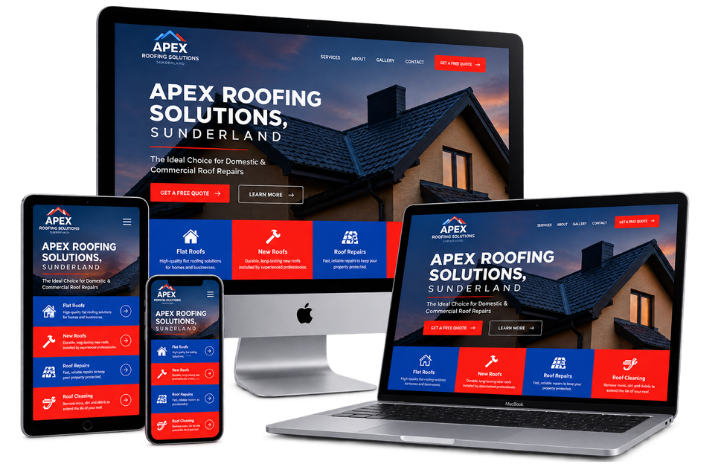
Apex Roofing Solutions
A Proper Website for a Proper Local Roofing Business
There are some businesses where people are quite happy to browse, have a nose around and come back another day.
Roofing generally isn’t one of them.
If somebody is searching for a roofer, there’s usually a reason.
Maybe the roof is leaking. Maybe a few tiles have decided they no longer wish to be attached to the house. Maybe the flat roof has seen better decades. Or perhaps they’ve reached the rather more expensive conclusion that the whole thing needs replacing.
Whatever brought them to Google, they’re looking for somebody they can trust to sort it out.
That was the thinking behind the website for Apex Roofing Solutions, a roofing company based in Sunderland.
The brief wasn’t to build something flashy for the sake of winning design awards.
It was to create a professional WordPress website that looked established, explained the company’s services properly, worked brilliantly on mobile and made it ridiculously easy for potential customers to get in touch.
Because that’s the job.
The Challenge
Roofing is competitive.
Very competitive.
Search for a roofer in Sunderland and you’re not exactly going to be presented with three carefully selected options.
There are established roofing companies, independent tradespeople, national directories, lead-generation websites, sponsored results and the inevitable collection of websites that look as though they haven’t been touched since broadband arrived.
Standing out matters.
But standing out doesn’t necessarily mean being louder.
For Apex, it meant looking credible.
People inviting a roofing company to work on their home are making a fairly substantial decision. They want to know they’re dealing with a legitimate business. They want to see what services are offered, where the company works and whether there’s evidence that they actually know what they’re doing.
They also want to find that information without battling through pop-ups, confusing menus and six paragraphs about the company’s “passion for delivering innovative roofing solutions”.
Nobody has time for that.
The website needed to feel professional, straightforward and reassuring from the moment somebody arrived.
And underneath all of that, it needed a structure that gave Apex a sensible foundation for local SEO.
Starting With the Customer, Not the Website
One of the easiest mistakes to make when designing a website is starting with the website.
What should the homepage look like?
What colours should we use?
Should that photograph go on the left or the right?
Can we make something slide in dramatically when somebody scrolls?
Those questions have their place.
Just not at the beginning.
At AuthoritySites, I prefer to start with the person we’re actually asking to use the thing.
For Apex Roofing Solutions, that’s likely to be a homeowner who needs roofing work carried out and is trying to decide who to trust.
Sometimes they’ll be researching.
Sometimes they’ll be comparing quotes.
And sometimes they’ll have just discovered water coming through the ceiling and their enthusiasm for exploring an elaborate website experience will be understandably limited.
So the website needed to answer the important questions quickly.
Who are you?
What do you do?
Do you cover Sunderland?
Can I see your work?
How do I contact you?
Get those things right and you’ve already removed a surprising amount of friction.
Making a Strong First Impression
A local business website doesn’t have long to establish credibility.
People make judgements quickly online, particularly when they’re comparing several companies offering essentially the same service.
That made the opening section of the Apex website particularly important.
We didn’t need paragraphs of corporate waffle.
We needed clarity.
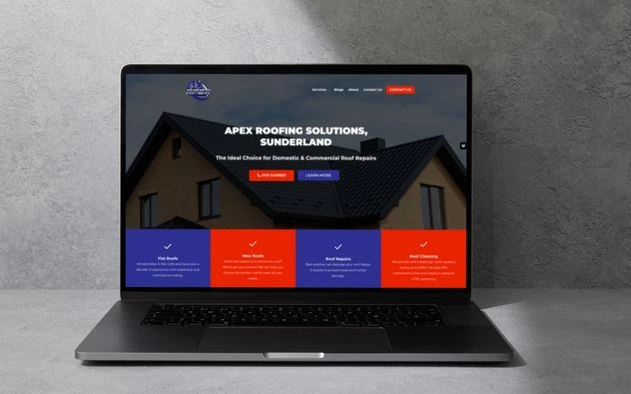
The design immediately establishes that Apex is a roofing company, makes the Sunderland location clear and gives visitors an obvious way to take the next step.
Strong roofing imagery does some of the heavy lifting visually, while clear typography and concise messaging keep the important information front and centre.
The result feels confident without trying desperately to look impressive.
Which is exactly where I wanted it.
Good website design shouldn’t make people stop and admire how clever the website designer has been.
It should make using the website feel obvious.
A Design That Actually Fits the Business
There’s no shortage of ready-made roofing website templates.
You know the ones.
Man on roof.
Big blue button.
Three little icons.
“Quality You Can Trust.”
Job done.
Except it isn’t.
The problem with building a website around a generic industry template is that you immediately inherit somebody else’s decisions about how your business should look, what information matters and how customers should move through the site.
For Apex, I wanted something that felt more considered.
The visual identity is strong and practical. The typography has weight. The photography puts the actual service front and centre. There’s enough space to make the website comfortable to read without making everything feel sparse.
It feels modern, but not fashionable for the sake of being fashionable.
That’s an important distinction.
Website trends come and go remarkably quickly. A local roofing company doesn’t need to rebuild its website every eighteen months because this year’s fashionable gradient has suddenly become embarrassing.
The design needed some staying power.
Giving Every Service Somewhere to Live
This is where website structure starts doing some serious work.
It’s tempting with small-business websites to put absolutely everything on the homepage.
Roof repairs.
New roofs.
Flat roofing.
Guttering.
Chimneys.
Areas covered.
Testimonials.
About us.
FAQs.
Three paragraphs about quality workmanship.
Another button.
Another testimonial.
And before long, the homepage has become the digital equivalent of that kitchen drawer where batteries, takeaway menus and mystery keys go to die.
We took a more organised approach.
The homepage introduces the business and its core services, then allows visitors to move naturally into the parts of the website relevant to them.
Individual services have room to be explained properly.
That’s better for customers because somebody looking for a roof repair isn’t necessarily interested in reading everything Apex has ever done.
It’s also better for SEO.
Instead of expecting one page to rank for every roofing-related search imaginable, the website has a structure that can support individual services and search intentions properly.
Simple structure.
Clear journeys.
No mystery drawer.
Mobile Wasn’t an Afterthought
This matters particularly for local businesses.
People don’t only search for roofers from a laptop while sitting peacefully at the kitchen table with a cup of tea.
They search on their phones.
They search after spotting something wrong with the roof.
They search when somebody recommends a company.
They search when they’re standing outside looking at the problem.
And occasionally, presumably, while staring at a suspicious damp patch on the ceiling.
So the Apex website wasn’t designed for desktop and then squeezed until it technically fitted on a phone.
The mobile experience was considered throughout the project.
Navigation becomes simpler. Content remains readable. Buttons are easy to tap. Images scale properly. Contact information is easy to find.
Nothing revolutionary.
Just lots of small decisions that make the website nicer to use.
And those small decisions are usually what separate a website that merely works on mobile from one that has actually been designed for it.
Built With WordPress
Apex Roofing Solutions was built on WordPress.
Not because WordPress happens to be something I know how to use, but because it’s a very good fit for this kind of business.
It gives Apex ownership and flexibility.
The website can change as the business changes.
New services can be added. Existing pages can be expanded. Project galleries can grow. New locations can be targeted where appropriate. Blog content can be published. Testimonials can be added.
The company isn’t trapped with a website that can only do what it did on launch day.
That’s something I care about with AuthoritySites projects.
Your website should belong to you.
You shouldn’t need to rebuild the entire thing because you want to add another service in two years’ time.
And you shouldn’t be held hostage by your website designer because changing a sentence apparently requires a support ticket, three working days and a minor financial negotiation.
If you want help managing it, brilliant.
If you want to manage normal content yourself, you should be able to.
SEO Was Part of the Build, Not Something Sprinkled on Afterwards
SEO has an unfortunate habit of being treated like fairy dust.
Build the website.
Make it look nice.
Then invite somebody along at the end to “SEO it”.
That’s not really how I work.
Search visibility is affected by decisions made long before somebody writes a meta description.
- How the website is structured matters.
- How pages relate to one another matters.
- What each page is actually about matters.
- The headings matter.
- The content matters.
- Internal links matter.
- Performance matters.
And for a business such as Apex Roofing Solutions, location matters quite a lot.
The website was therefore built with local search in mind from the beginning.
Someone searching broadly for “roofing” could be anywhere and looking for almost anything.
Someone searching for a roofer in Sunderland or roof repairs in Sunderland is telling us considerably more.
That’s the kind of intent a local business website needs to understand.
So instead of stuffing Sunderland into every other sentence until the copy sounds as though it has developed a nervous tic, the site creates a logical relationship between the business, its services and the area it serves.
Useful for Google.
Far more importantly, useful for the person actually reading it.
Designed to Build Trust
A good roofing website can’t manufacture trust.
But it can make genuine trust easier to see.
That’s an important difference.
The design gives Apex space to showcase completed projects, customer feedback, services and the practical information people need before making contact.
Over time, that becomes increasingly valuable.
Every completed project is another opportunity to demonstrate workmanship.
Every genuine testimonial gives potential customers another reason to feel comfortable.
Every useful service page helps somebody understand what they’re paying for.
This is one of the reasons I don’t think of a website as something you simply “finish”.
You launch it.
Then it has a life.
A good website should become more useful and more authoritative as the business gives it more to work with.
Room to Grow
Apex doesn’t need to know today exactly what the business will look like three years from now.
Neither do I.
That’s rather the point.
A properly built website should leave some room for real life to happen.
Perhaps the company adds another roofing service.
Perhaps it starts working more heavily in another area.
Perhaps project case studies become an important part of its marketing.
Perhaps SEO becomes a bigger source of enquiries and additional content is needed.
The website has been built so those things can happen without starting again from scratch.
Because rebuilding your website every time your business evolves gets expensive.
And irritating.
The Finished Result
The finished Apex Roofing Solutions website isn’t trying to reinvent roofing websites.
It doesn’t need to.
What it does is present the business properly.
It gives Apex a strong, professional online presence that feels appropriate for a local roofing company while still having enough personality to avoid disappearing into a sea of identical trade websites.
The services are clear.
The navigation makes sense.
The mobile experience works.
The company has somewhere to showcase its workmanship.
Potential customers can find what they need without hunting for it.
And the underlying structure gives Apex room to develop its local search presence over time.
That’s what I consider a successful small-business website.
Not something designed purely to look impressive in my portfolio.
Something designed to be useful in theirs.